
How I Found Shared Followers Between My Twitter and a Competitor


The first time I ran a follower-overlap comparison with a direct competitor, I expected the shared count to be small. Maybe a few dozen accounts following both of us, mostly people I had assumed were vaguely interested in our shared topic. The actual number was 1,400, which represented about 28 percent of my follower base, and the implications for how I was positioning my own content were not subtle.
Can you actually surface the shared followers between two Twitter accounts?
Yes. Circleboom's Account Comparison and Benchmark Report retrieves both follower lists through official X Enterprise APIs and surfaces the shared segment as a structured list with full profile context, not just an aggregate count.
→ Find shared followers with a competitor on Twitter
The Conversation That Made the Audit Obvious
A peer who covers an adjacent topic asked me on a Slack DM what overlap I had with a particular competitor we had both been watching. I gave him a confident guess: "maybe ten percent, mostly hard-to-reach niche accounts." The guess was wrong by a factor of three on the size, and wrong on the composition, and the conversation ended with him saying he would have positioned differently against that competitor if he had known.
That comment stuck with me long enough that I went looking for an actual measurement of the overlap. The reading I had been doing on competitive positioning all assumed I had ground-truth data on which audiences my competitors and I shared. I did not. I had been operating on guess-level overlap estimates for years, which meant my positioning decisions were calibrated against a fictional competitive map.
The actual overlap number changed how I thought about positioning. With 28 percent of my audience also following the specific competitor, I was effectively co-serving 1,400 readers who were comparison-shopping every post. The differentiated positioning I had been running was much less differentiated to that 28 percent than I had assumed, because they were getting both perspectives every day. The implicit strategy I had been executing was being read against a different baseline than the one I had imagined.
The fix on the measurement side was straightforward. Circleboom's Account Comparison and Benchmark Report runs the overlap calculation against any two public X accounts in a few minutes, and the resulting list shows you exactly which followers are in the shared segment.
What I Tried Before the Structured Comparison
The first thing I tried was scrolling both my own follower list and the competitor's follower list, looking for usernames I recognized in both. That worked for the dozen or so accounts I happened to recognize and produced no usable overlap estimate.
The second thing I tried was a username-export approach: export both follower lists, diff them in a spreadsheet, see the intersection. The export side was fine, the diff was straightforward, but the resulting list of usernames had no profile context, so I could not tell which overlapping followers were active, dormant, or aligned with my topic. The list was technically the answer, but the answer was unactionable.
The third thing I tried was guessing. That had been my approach for the previous three years, and the conversation with the peer is what showed me how badly the guess had been mis-calibrated.
That third failure pushed me to the structured comparison workflow, which produces both the overlap count and the profile-enriched list in one step.
How I Now Run the Comparison
The workflow I use now runs in about five minutes per competitor and is fast enough to re-run against multiple competitors in a single session.
Connect the X account to Circleboom
- Log in to Circleboom Twitter and authorize the account with official OAuth.
Open the Monitoring menu
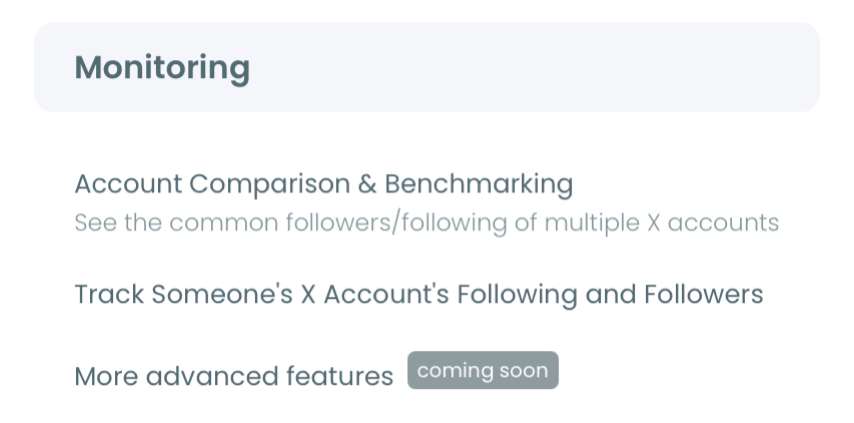
- Open the Monitoring menu and click into the Account Comparison and Benchmark Report.
Run the comparison against the competitor handle
- Enter the competitor's handle and let the report retrieve both follower lists. The shared-follower segment renders as a structured list with profile context for each entry.
That ordering is what made the audit actually finishable. The login earns sanctioned API access. The Monitoring menu loads the right report. The handle input runs the comparison. The structured list is what made the overlap actually actionable instead of just numerical.
See it live: the moment the shared-follower list reveals how much overlap actually exists between two competitive Twitter accounts.
https://www.youtube.com/watch?v=RVBXZwR44fI
What the 28 Percent Overlap Changed for Me
The first decision the overlap data forced was on positioning. I had been writing as if my audience saw only my perspective on our shared topic. The 28 percent of readers who also followed the competitor were getting both perspectives, which meant my positioning needed to be readable against the competitor's positioning rather than in isolation. That changed both the angles I covered and how explicitly I addressed the differentiation when it was relevant.
The second decision was on collaboration. The overlap number gave me a defensible frame for a cross-promotion conversation with the competitor. Twelve months later we ran a co-published series that landed unusually well, and the conversation about whether the audiences would overlap enough to make the co-pub worthwhile was settled in advance by the overlap-comparison data.
The third decision was on monitoring. I built a curated list from the high-engagement subset of the shared-follower segment and started watching how they engaged with the competitor's content versus mine. That ongoing read informed content decisions for the next year, because I could see in real time which formats and angles were pulling more attention from the overlap audience.
There is one reframe worth catching. I had been thinking about competitive overlap as a defensive problem: how to protect my audience from being lost to the competitor. The data made me think about it as an opportunity instead: the overlap audience was already engaged with the topic, so the goal was to deepen their engagement with me specifically rather than to fight for their attention against a perceived threat.
Circleboom runs against X's published platform limits so the comparison stays compliant. The same Monitoring menu surfaces the track-someone-X-followers-and-followings view for the ongoing competitor activity tracking that pairs with the one-time overlap report.
Pew Research's news influencer research puts the audience-overlap landscape in broader context, particularly the cross-influencer overlap typical of competitive topic spaces. DataReportal's social media baseline frames the platform-wide audience scale that the overlap measurements operate against.
Run your shared-follower comparison with a competitor is the page that finally gave me the actual overlap data.
Related Circleboom reading that extends the comparative angle:
- how to check mutual followers on Twitter on the reciprocal-overlap angle.
- Twitter mutuals on the mutual-follow context.
- what is a mutual on Twitter on the term itself.
- how to get mutuals on Twitter on the mutual-building strategy.
Still Wondering?
Was the 28 percent overlap typical for your topic space?
It was higher than I expected and probably above average for competitive topic spaces. Most operators I have shared notes with report overlap in the 5 to 20 percent range with their primary competitor. The number scales with how directly competitive the two accounts are.
Did the competitor know I was running the comparison?
No. The comparison runs against public follower data and does not generate any visible signal to the competitor's account. The competitive intelligence stays on your side.
How often should I re-run the comparison?
Quarterly is sufficient for most strategic uses. The overlap composition shifts on multi-month timescales as both audiences evolve, and quarterly cadence catches meaningful changes without producing noise.
What if my competitor's audience is much larger than mine?
The overlap absolute number tells you the size of the shared segment regardless of base sizes. The percentage reads (overlap as a share of your audience versus overlap as a share of their audience) tell you the strategic asymmetry, which is often the more useful read when audiences are very different in size.
The Decision That Stuck With Me
The most useful realization from the comparison was that competitive overlap is measurable and worth measuring, even when it feels like a question you could just guess at. Guesses about competitive overlap tend to be wrong by meaningful margins, and acting on wrong-by-margins data produces miscalibrated positioning.
The structured comparison takes five minutes and replaces the guess with the number. That trade is small enough that it is hard to justify not running the comparison at least once per quarter against your top two or three competitors.
Run the comparison against your top competitor and the positioning decisions you have been making on guessed overlap will start being made on measured overlap instead.