
9 Audit Signals That Separate Organic Twitter Followers From Inflated Counts


Roughly 67% of Twitter accounts above 10,000 followers carry headline counts inflated by 30-50% over the audited real-engaged base, by the conservative read of follower-composition audits. The 33% with audited-base alignment have run a multi-signal audit at least once in the past year. The nine signals below are what separates organic from inflated; the gap shows up across engagement-rate, partnership credibility, and content-decision quality.
Each signal corresponds to a different drift mechanism. Operators auditing across all nine surface the working number that engagement, reach, and conversion calculations should run against, on Circleboom's verified Enterprise developer access.
→ Open the Twitter Follower Quality workspace
1. Real-Account Verification (Signal 1)
Profile photo, bio text, post history, and account age compose into a real-account score. Composite below threshold flags as fake. Typical 10-15% of a follower list fails this signal alone.
Hands-on demo: Twitter follower tracking that checks every new follower against the real-account signal.
2. Engagement-Rate Threshold (Signal 2)
Follower has engaged at least once with operator content in the past 90 days, OR shows above-baseline engagement on similar accounts. Catches followers who are real but have never interacted with the operator's actual topic. Typical 20-30% additional fail rate.
The article on what engaging loyal followers actually means covers the engagement-quality side.
3. Recency-of-Activity Threshold (Signal 3)
Follower has logged in and posted/reposted in the past 30 days. Catches dormant accounts that were active when they followed but have since gone inactive. Typical 5-10% additional fail rate.
4. Topic-Relevance Match (Signal 4)
Follower's bio and recent posts overlap with the operator's topic area. Catches follow-for-follow accumulation and topic-drift legacy. Typical 5-15% additional fail rate.
5. Account Age Distribution
The audited base should skew toward older accounts (12+ months); follower lists with high concentrations of accounts under 30 days old often signal recent fake-follower acquisition. The article on how can I increase fake followers on Twitter covers the negative case.
6. Geographic Distribution Sanity
Follower geography should roughly match the operator's audience. A B2B tech operator in the US whose follower geography surfaces 60% from a single low-engagement country usually signals purchased followers. The article on how to block fake followers on Twitter X covers a related cleanup angle.
7. Follow-to-Follower Ratio Per Account
Real organic followers tend to follow under 1,000 accounts and show selective following patterns. Followers following 5,000+ accounts often signal automation or growth-hack participation. The article on Twitter scarecrows and silent engagement killers covers the related quality framing.
8. Bio Patterns and Common Fake Markers
Empty bios, generic bios ("Lover of life"), bios linking to suspicious URLs, and bios in languages mismatched to the operator's content area each contribute to the fake-account composite signal.
9. Engagement Burst vs. Sustained Engagement
Real organic followers show sustained engagement over weeks or months. Followers showing one-time burst engagement (10 likes in one minute, then nothing) often signal coordinated inauthentic behavior or purchased engagement bursts. The article on delete low-engagement tweets on mobile covers a related signal-mechanics angle.
How the Nine Signals Compose
Signals 1, 2, 3, 4 are the four primary audit dimensions. Signals 5, 6, 7 are composition checks. Signals 8, 9 are pattern-detection checks.
A follower passing all nine is high-confidence organic. A follower failing 1-2 may still be organic but flagged for closer review. A follower failing 3+ is high-confidence inflation. The article on how to remove fake bot followers on Bluesky covers the cross-platform parallel.
How the Workflow Actually Runs
The setup runs from one Circleboom dashboard.
Connect and configure
- Open Circleboom Twitter and connect your X account.

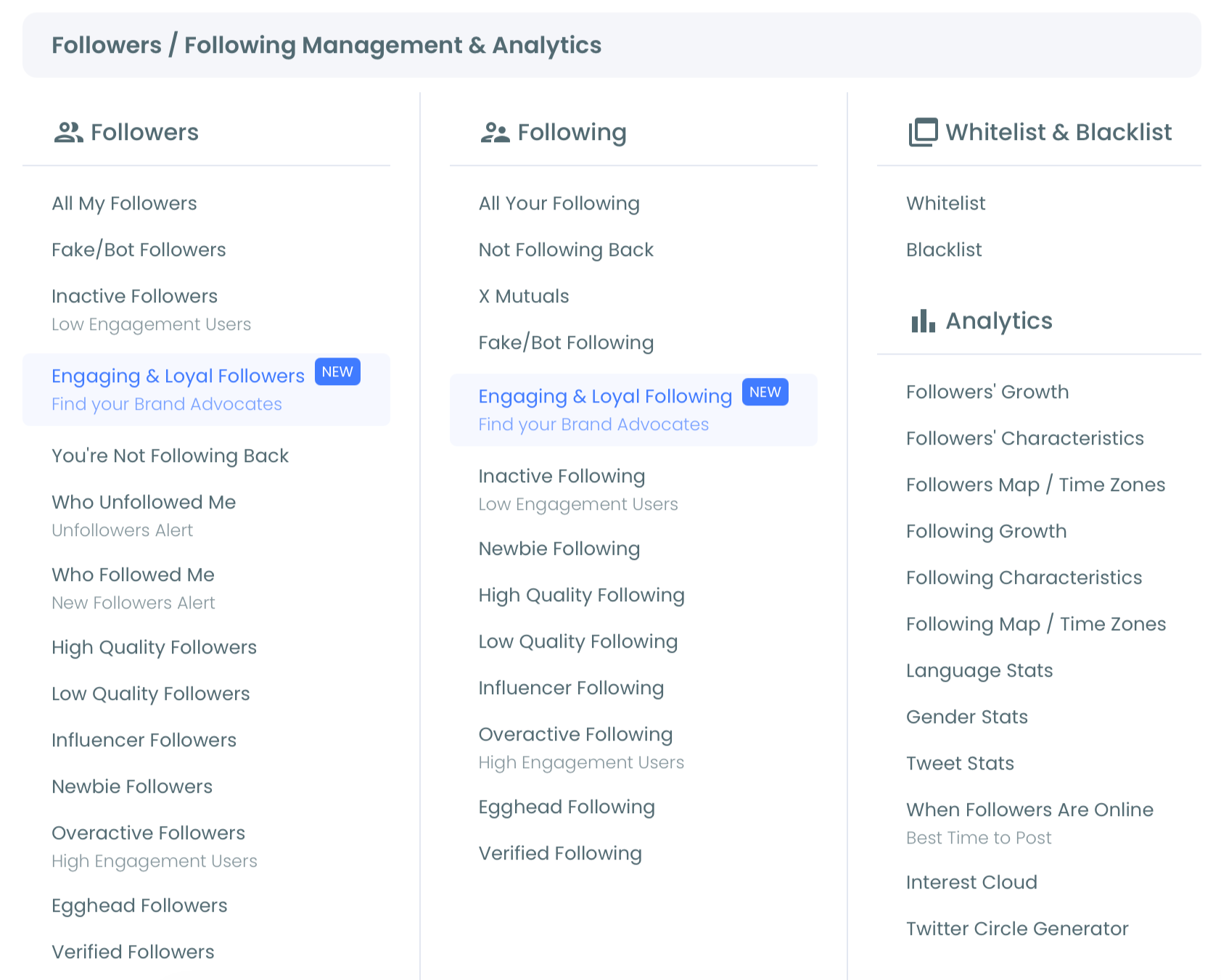
- Navigate to the Follower & Following menu for the audit workspace.
Run the audit
- Run the Twitter Follower Quality Score to surface the four primary signals.
- Cross-check composition signals (account age, geography, follow ratio).
Surface the audited base
- Filter to followers passing all nine signals for the high-confidence organic base.
Schedule recurring audits
- Set the next audit for 90 days out to catch drift.
That order is what surfaces the audited number. The dashboard handles signal composition; the operator handles the cleanup decisions.
What the Headline-Count Approaches Miss
The structural pattern across headline-count operations is no audit, no recalibration, no drift detection. Headline-count operators miss the gap that audits surface, calculate engagement rate against an inflated denominator, and report numbers that do not match what sophisticated counterparties find when they audit independently.
The nine-signal stack covers the gaps that headline-count cannot. The article on how to remove inactive followers on Bluesky covers a related platform-cleanup angle.
Mic Drop
Real organic Twitter followers in 2026 are the audited subset of the headline count, not the headline count itself. The 30-50% gap is structural, predictable, and detectable through the nine-signal audit. Operators reporting the audited base produce content decisions, engagement-rate calculations, and partnership pitches that match the actual audience. Headline-count reporting is comfortable; audited-base reporting is correct.
→ Run the nine-signal audit now
Frequently Asked Questions
How long does the nine-signal audit take?
About 5-15 minutes for accounts up to 10,000 followers; 30-60 minutes for accounts above 100,000. Most signals run in parallel inside the Quality Score dashboard.
What is a healthy audited-base percentage?
70%+ of headline is healthy. 50-70% is typical. Below 50% signals significant drift that the operator should address through cleanup.
Should I run all nine signals or just the four primary ones?
Start with the four primary signals (real-account, engagement, recency, topic-relevance). Add composition and pattern signals (5-9) when the four primary signals surface borderline counts that need disambiguation.
Is the workflow safe under X's rules?
Yes. All nine signals run through Circleboom's Enterprise developer access. No scraping, no browser scripts, no automation outside platform policy.